
Have I Committed the Unforgivable Sin? All Sins Will Be Forgiven
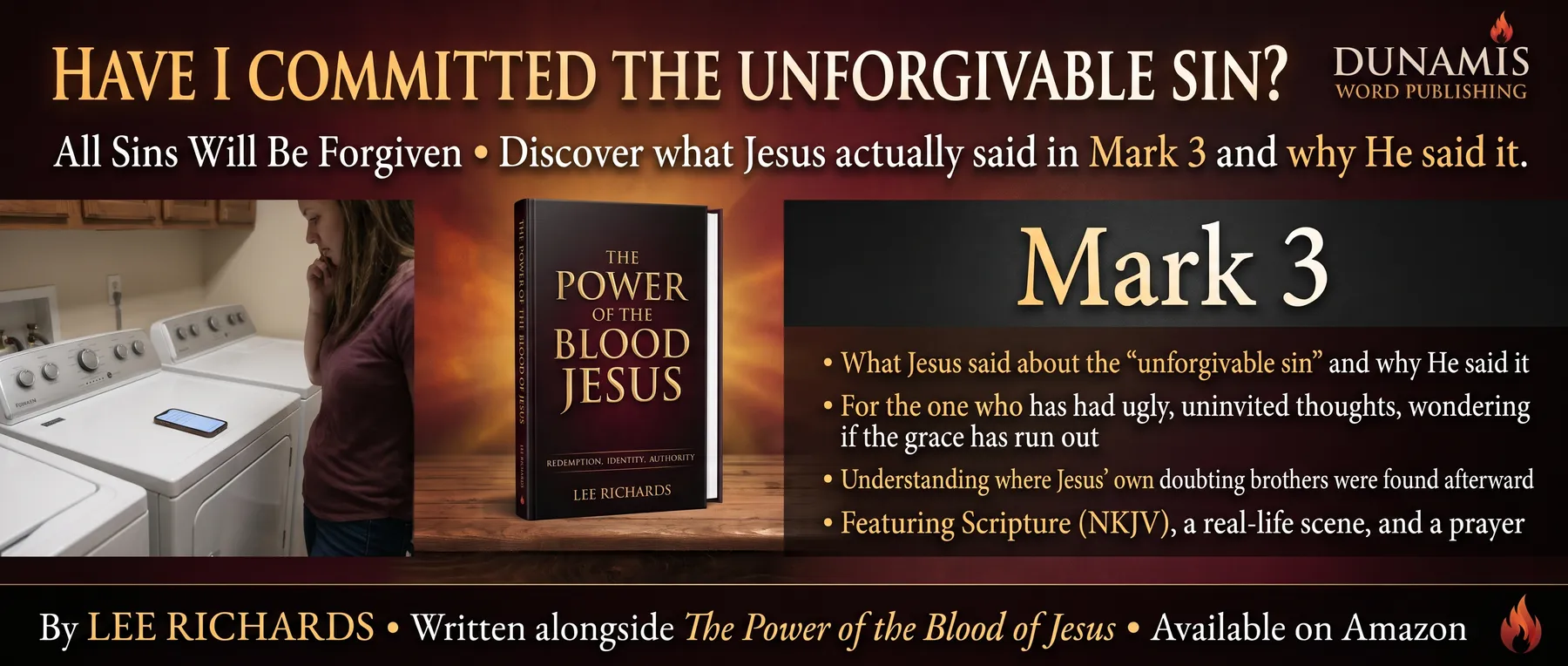
It’s 4:10 on a Sunday afternoon, and you’re standing in the laundry room with your phone on top of the dryer.
The search bar still says what you typed: have I committed the unforgivable sin. Fourth time this week. The dryer thumps a pair of sneakers around and around.
It happened this morning, during the Scripture reading. A sentence about God came into your head, ugly and uninvited, and you can still hear the shape of it. You didn’t stand for the last hymn. You kept your eyes on the hymnal rack and counted the screws.
You put the phone face-down on the dryer. You pick it back up.
The short answer: The sin Jesus warned about is not a stray thought, and it is not a sentence said in grief. He began His warning with forgiveness: “Assuredly, I say to you, all sins will be forgiven the sons of men, and whatever blasphemies they may utter” (Mark 3:28). The one exception, blasphemy against the Holy Spirit, Mark explains in the very next breath: “because they said, ‘He has an unclean spirit’” (Mark 3:30). It was the verdict of men who watched the Spirit set people free through Jesus and called it the devil’s work. And Paul says “no one can say that Jesus is Lord except by the Holy Spirit” (1 Corinthians 12:3).
A House So Full They Couldn’t Eat
Mark sets the scene in a house. The crowd presses in until there’s no room at the table, “so that they could not so much as eat bread” (Mark 3:20).
Then two groups start walking toward that house.
The first group is His own family. “But when His own people heard about this, they went out to lay hold of Him, for they said, ‘He is out of His mind’” (Mark 3:21).
The second group comes from farther away. “And the scribes who came down from Jerusalem said, ‘He has Beelzebub,’ and, ‘By the ruler of the demons He casts out demons’” (Mark 3:22). They’ve seen the demons leave. They don’t deny it happened. They tell the crowd whose power did it.
The Word He Used Three Times
Jesus calls the scribes over. Then He says this:
“Assuredly, I say to you, all sins will be forgiven the sons of men, and whatever blasphemies they may utter; but he who blasphemes against the Holy Spirit never has forgiveness, but is subject to eternal condemnation” (Mark 3:28–29).
The word for “blasphemies” is blasphēmia (slander, speech that injures someone’s name), and the word for “blasphemes” is its verb, blasphēmeō (to speak reproachfully, to revile). Jesus uses that word three times in two verses: the noun in “blasphemies,” the verb inside “they may utter,” the verb again in “he who blasphemes.” Twice, it sits under forgiveness. Once, it stands outside.
And Mark won’t let you guess which one that is. “Because they said, ‘He has an unclean spirit’” (Mark 3:30). The Spirit of God was setting captives free in front of their eyes, and they looked straight at Him and said unclean.
Standing Outside the Door
Now watch the doorway.
Mark began this scene with His own people setting out to lay hold of Him. He closes it with His family arriving. “Then His brothers and His mother came, and standing outside they sent to Him, calling Him” (Mark 3:31). Jesus gives the warning about the one sin with no forgiveness, and the next thing Mark records is His family standing outside the door.
They didn’t change their minds that afternoon. Later, with the Feast of Tabernacles at hand, John says it flatly: “For even His brothers did not believe in Him” (John 7:5).
Then turn to the book of Acts. Jesus has risen and ascended. Eleven men climb to an upper room in Jerusalem to wait for the Spirit He promised. And Luke takes the roll: “These all continued with one accord in prayer and supplication, with the women and Mary the mother of Jesus, and with His brothers” (Acts 1:14).
With His brothers.
Here is what is actually true. His brothers stood outside the door in Mark 3, with the family that had said the Son of God had lost His mind. In Acts 1 they were inside the room, praying, waiting for the Holy Spirit. Their worst sentence about Him did not close the door. It was not the sentence Mark 3:30 names.
So here is what you can stop doing. You can stop replaying the thought from the Scripture reading to test whether it was the one. You can stop typing the same question into the search bar on Thursday and Sunday and the Thursday after. Jesus said it Himself: “the one who comes to Me I will by no means cast out” (John 6:37). And what covers “all sins” was never your vigilance: “In Him we have redemption through His blood, the forgiveness of sins” (Ephesians 1:7). If your conscience keeps the record running anyway, here is what Hebrews 9:14 says about the blood that cleanses the conscience.
At the Paint Counter
I said it out loud. That has to be worse than thinking it.
You think it at 10:40 on a Thursday at the paint counter, while a gallon of eggshell white rattles in the shaker. It was twenty-six years ago, the March your brother’s truck went off the levee road, and you stood in your mother’s side yard and said a sentence to the sky that you’ve never repeated. You’re fifty-one now, the one who runs the paint counter at the hardware store, and you’ve taught the fourth-grade Sunday school class for nine years. Last week a boy named Tyler asked what the unforgivable sin was, and you said, “Let’s ask Pastor,” and went and ran the water in the restroom sink.
This morning you copied two verses onto an index card. It’s in your apron pocket with the tint chart.
The shaker clunks to a stop. You don’t lift the can out yet. You take the card out and read the front, under your breath: all sins will be forgiven the sons of men. You turn it over. With His brothers.
“Jesus is Lord,” you say.
The bell on the front door jingles. You set the card on the counter, face up, and lift out the can.
Say the Sentence Only the Spirit Gives
Here’s the one thing to do today. Open to Mark 3:28–30 and read it out loud, all three verses, the hard part included. Then turn to Acts 1:14 and read it out loud, slowly, through the last four words.
Then say one sentence, out loud, in your own voice: “Jesus is Lord.”
Stop there. Don’t go back to the search bar to check whether it worked. Paul already told you where that sentence comes from. And if you’re asking whether the Spirit lives in you at all, read what it means that the Spirit cries “Abba, Father” in you.
Scripture to Keep When the Thought Comes Back
- “Assuredly, I say to you, all sins will be forgiven the sons of men, and whatever blasphemies they may utter.” (Mark 3:28)
- “These all continued with one accord in prayer and supplication, with the women and Mary the mother of Jesus, and with His brothers.” (Acts 1:14)
- “Therefore I make known to you that no one speaking by the Spirit of God calls Jesus accursed, and no one can say that Jesus is Lord except by the Holy Spirit.” (1 Corinthians 12:3)
- “In Him we have redemption through His blood, the forgiveness of sins, according to the riches of His grace.” (Ephesians 1:7)
A Prayer for the One Standing Outside the Door
Father, I have been asking whether I said or thought the one thing You will not forgive. Here is what I have been carrying: [name it plainly]. You said all sins will be forgiven the sons of men. You put the brothers who stood outside the door in the upper room, praying. I am coming to Jesus, and He said He will by no means cast me out. Jesus is Lord. Wash me in His blood, and quiet the replaying. In Jesus’ name, amen.
The Power of the Blood of Jesus was written for the one who keeps checking whether the blood reached far enough: twenty-eight chapters on redemption, cleansing and identity, so you can live in a finished work.
I heard the sentence during the Scripture reading, child. I’m not shocked by it. His family said He’d lost His mind. I had His brothers praying in the upper room. You just said “Jesus is Lord.” You didn’t say that by yourself. Put the phone down. Stop checking the door. You’re already inside.
His own family once said He was out of His mind, and Luke found His brothers in the upper room, praying. The warning was spoken over a doorway, and the ones standing outside it came in.
Keep Reading
Scripture taken from the New King James Version®. Copyright © 1982 by Thomas Nelson. Used by permission. All rights reserved.