
Pleading the Blood of Jesus: When I See the Blood
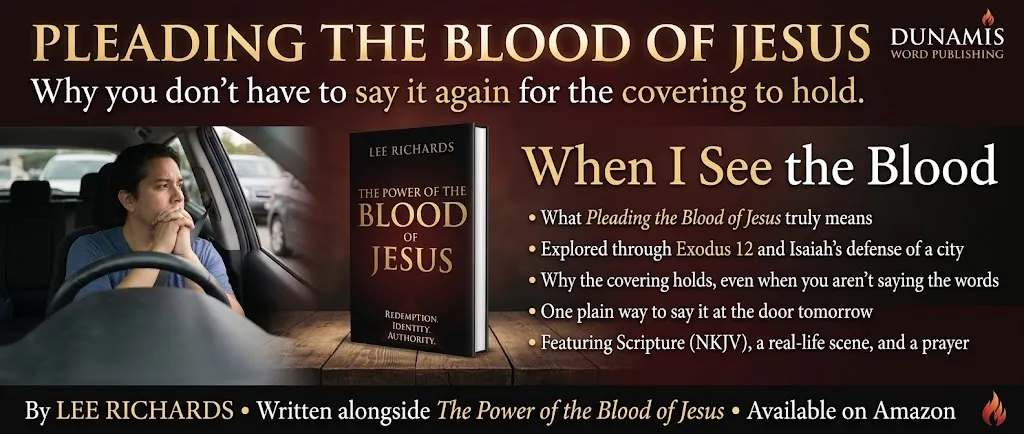
“I plead the blood of Jesus over Micah.”
That’s the fourth time since the light on Ridgeway, and you’re only third in the drop-off line.
Micah has one earbud in and his backpack on his knees. The text from the school came at 6:30: precautionary police presence at the middle school today. No details. You said it the way your aunt taught you: once at the light, once at the crosswalk, and twice in the line, because a bus horn went off in the middle of the second one.
The car ahead pulls forward. Micah’s hand is on the door handle.
And under all four is the question you won’t say out loud: does it only hold if you say it right?
The short answer: Pleading the blood of Jesus means asking God to cover you and the people you love on the ground of what His Son’s blood has already done. The phrase itself is not in the Bible, but the confidence under it is: “And when I see the blood, I will pass over you” (Exodus 12:13). The covering does not depend on how often or how well you say it. God is the One who looks at the blood, and “Christ, our Passover, was sacrificed for us” (1 Corinthians 5:7).
Hyssop, a Basin, and a Shut Door
The lamb was killed at twilight. Now a father in Goshen stands at his own front door with a bunch of hyssop in his hand and a basin at his feet, and he does exactly what he was told:
“And you shall take a bunch of hyssop, dip it in the blood that is in the basin, and strike the lintel and the two doorposts with the blood that is in the basin. And none of you shall go out of the door of his house until morning.” (Exodus 12:22)
The lintel. The left post. The right post. Then he steps inside and pulls the door shut.
The table is set for leaving. “And thus you shall eat it: with a belt on your waist, your sandals on your feet, and your staff in your hand” (Exodus 12:11). His children eat roast lamb with their sandals laced. Nobody goes back out to see whether the blood is still wet. Nobody takes the hyssop out at midnight for a second coat. They put it up once, and they eat.
Because of what God said about whose eyes would be on that door: “Now the blood shall be a sign for you on the houses where you are. And when I see the blood, I will pass over you; and the plague shall not be on you to destroy you when I strike the land of Egypt.” (Exodus 12:13)
When I see. The family did their part at twilight. The seeing was His.
What “Pass Over” Means
The word is pāsaḥ, “to pass over, to spare.” In that sense the Old Testament uses it only four times. Three are on that one night (Exodus 12:13, 23, 27). The fourth is in Isaiah, and it shows you what kind of passing over this is:
“Like birds flying about, So will the LORD of hosts defend Jerusalem. Defending, He will also deliver it; Passing over, He will preserve it.” (Isaiah 31:5)
There it is again, pāsaḥ, to pass over, set in one line with defend, deliver and preserve. Picture it the way Isaiah does: wings moving over a city, defending it. Those wings aren’t skipping the city. They’re over it.
Exodus says it in plain words, too: “For the LORD will pass through to strike the Egyptians; and when He sees the blood on the lintel and on the two doorposts, the LORD will pass over the door and not allow the destroyer to come into your houses to strike you.” (Exodus 12:23)
He passes over the door, and He does not allow the destroyer in. Passover was never God stepping around a house and moving on. It is God over the door, keeping the destroyer out.
The Door Is Already Marked
Here is what is actually true. The blood that covers you is not a fresh coat you put on each morning by saying the words. “For indeed Christ, our Passover, was sacrificed for us” (1 Corinthians 5:7). And He went where that blood is seen: “into heaven itself, now to appear in the presence of God for us” (Hebrews 9:24). The Father has His eyes on it right now, while you sit in the drop-off line.
So here is what you can stop doing. You can stop going back out to check the doorpost. You can stop saying it a fifth time because a horn went off during the fourth. The family in Goshen did not repaint the lintel every hour; they laced their sandals and ate.
When you say “the blood of Jesus” over your son, you are not painting a door. You are agreeing out loud with what God already sees. That is how the overcomers in Revelation used their mouths: “And they overcame him by the blood of the Lamb and by the word of their testimony” (Revelation 12:11). The blood did the work. Their testimony told the truth about it. There’s more on standing on the blood instead of reciting it, and on the seven things Scripture says the blood does.
When the Dot Stops Moving
Did I cover her?
You’ve asked it nine times since lunch, in the equipment trailer behind the band room, with the sousaphone cases stacked to the ceiling and valve oil on your fingers. Kenzie got her license in September. Today she’s driving herself to the away game, ninety minutes of interstate, because her shift at the pharmacy runs late. You’re the band director, forty-six, with a hundred and twelve kids to load onto three buses by 4:30.
The location app is open on your phone. The blue dot has sat at mile marker 61 for four minutes. You say it again: “I plead the blood over Kenzie.” Then once more, slower.
The dot doesn’t move.
You open your notes, where you typed Exodus 12:13 last Sunday, and you read it under your breath against the trailer wall: “And when I see the blood, I will pass over you.” You close the app with the dot still sitting at 61. You lift the first drum harness off its hook and carry it out to the buses.
Say It Once at the Door
Here is the one thing to do. Tomorrow morning, before anyone leaves, stand at your front door and put your hand on the frame. Say it once, by name: “Father, You see the blood of Jesus. Cover Micah,” and use the name that’s yours to say. Read Exodus 12:13 out loud. Then go back inside and pour the coffee.
Scripture to Keep at the Door
- “And when I see the blood, I will pass over you” (Exodus 12:13)
- “Like birds flying about, So will the LORD of hosts defend Jerusalem. Defending, He will also deliver it; Passing over, He will preserve it.” (Isaiah 31:5)
- “It is the Passover sacrifice of the LORD, who passed over the houses of the children of Israel in Egypt when He struck the Egyptians and delivered our households.” (Exodus 12:27)
- “For indeed Christ, our Passover, was sacrificed for us.” (1 Corinthians 5:7)
- “but into heaven itself, now to appear in the presence of God for us” (Hebrews 9:24)
A Prayer at the Door
Father, You see the blood of Your Son. I do not have to make You notice it, and I do not have to say it enough times for it to hold. Christ is our Passover, and He was sacrificed for us. I put [say the name] under that blood today, and I leave them with You. Stand over this door, and do not allow the destroyer in. I am going back inside to do the next thing, because Your eyes are on the door. In Jesus’ name, amen.
For the one who has sung it a thousand times, The Power of the Blood of Jesus traces the scarlet thread from Genesis to Revelation, down to the blood that covers you by covenant.
I saw the door, child. I saw it before you pulled into the line. You don’t have to say it again for Me to look. I’m not stepping around your house. I’m standing over it. My Son’s blood is in front of My eyes right now. Let him go in. I’ve got the door.
You do not keep the blood in His sight by saying it again. He sees it, and He stands over your door.
Keep Reading
Scripture taken from the New King James Version®. Copyright © 1982 by Thomas Nelson. Used by permission. All rights reserved.