
How to Be Thankful When Life Is Hard: For His Mercy Endures Forever
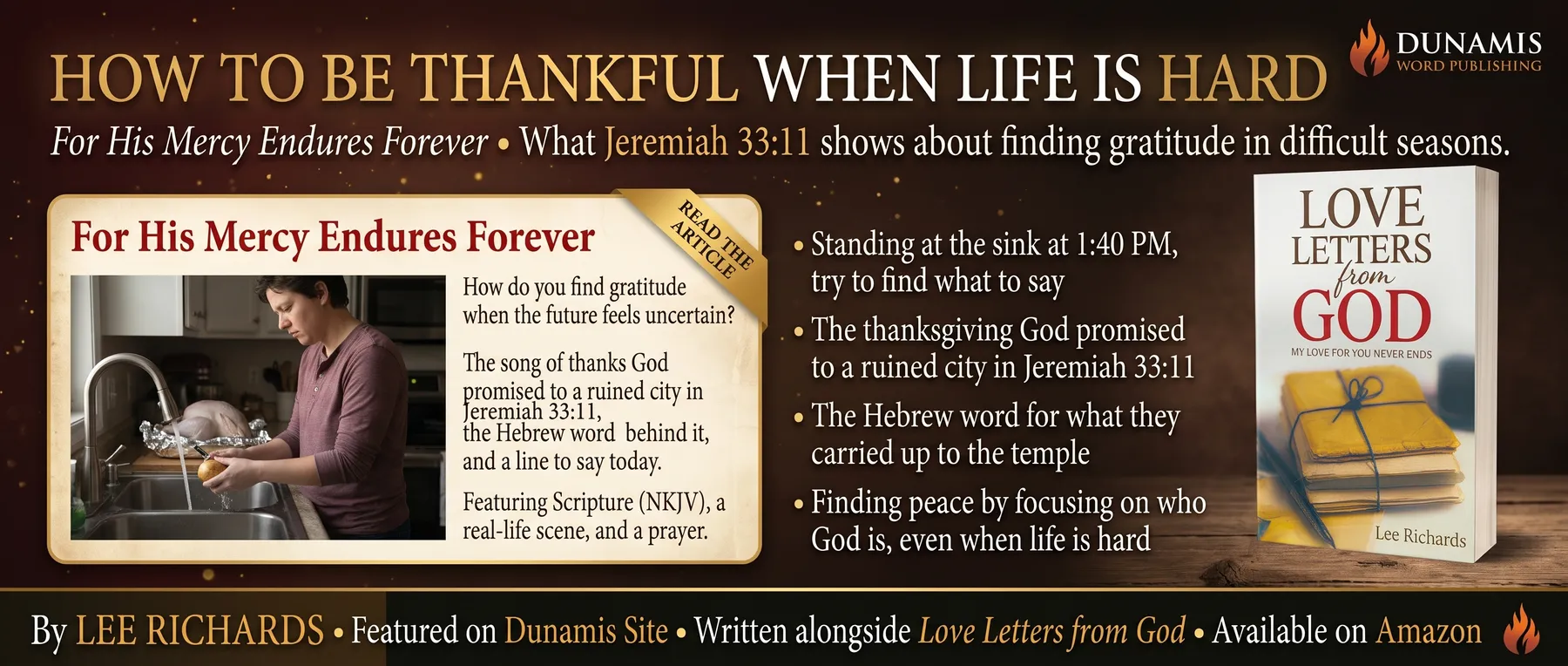
It’s 1:40. The turkey is resting under foil on the stovetop, and you’re at the sink with the potato peeler, working the same potato down to almost nothing.
In about forty minutes your aunt will tap her glass and say what she says every year: “Let’s go around and each say one thing we’re thankful for.”
You’ve been rehearsing since noon. The layoff came in April. The house went on the market in July. Since August you’ve been sleeping in your sister’s basement, under the window well, with your boxes stacked against the furnace. You keep trying sentences out under the water. I’m thankful for family. True. It also sounds like something read off a card.
You set the peeler down and look at your hands.
This page is for that sink. Because the line God gave His people for giving thanks was once promised to a place in much worse shape than your year.
The short answer: When life is hard, give thanks to God for who He is before you can give thanks for how the year went: “Oh, give thanks to the LORD, for He is good! For His mercy endures forever.” (Psalm 136:1) Scripture says “in everything give thanks” (1 Thessalonians 5:18), and God promised that very line, “For the LORD is good, For His mercy endures forever,” to streets He Himself called “desolate, without man and without beast” (Jeremiah 33:10–11). You do not have to wait for things to turn out before you thank Him. God handed out that song while the city still lay in ruins.
A Prophet Shut Up in the Prison Court
Babylon’s army is outside Jerusalem. “For then the king of Babylon’s army besieged Jerusalem, and Jeremiah the prophet was shut up in the court of the prison, which was in the king of Judah’s house.” (Jeremiah 32:2)
From where he is held, Jeremiah can name what he sees. “Look, the siege mounds! They have come to the city to take it” (Jeremiah 32:24). Earth piled against the walls. Famine inside them.
And that is where God speaks to him again. “Moreover the word of the LORD came to Jeremiah a second time, while he was still shut up in the court of the prison, saying,” (Jeremiah 33:1) “Call to Me, and I will answer you, and show you great and mighty things, which you do not know.” (Jeremiah 33:3)
Watch what He shows him. Not a sudden victory. Sound. “Again there shall be heard in this place—of which you say, ‘It is desolate, without man and without beast’—in the cities of Judah, in the streets of Jerusalem that are desolate, without man and without inhabitant and without beast” (Jeremiah 33:10)
Desolate. He says it twice. Then He tells Jeremiah what will be heard there: “the voice of joy and the voice of gladness, the voice of the bridegroom and the voice of the bride, the voice of those who will say: ‘Praise the LORD of hosts, For the LORD is good, For His mercy endures forever’—and of those who will bring the sacrifice of praise into the house of the LORD.” (Jeremiah 33:11)
A wedding in the street. And a line of people carrying something up to the temple.
The Word for What They Carried
“The sacrifice of praise” is one Hebrew word, tôdâ (H8426), “thanksgiving, thank offering.” It is the name of an offering the law already knew, the thank offering of Leviticus 7:12. The singers in the street give thanks, and the worshipers carry the thank offering up the hill.
Now here is what most readers walk past. God promised that procession while the city was still in ruins. He named the street “desolate” in the same breath. The thank offering, the tôdâ, “thanksgiving,” was promised to a place with no one left in it, and the words they would sing were already chosen: “For the LORD is good, For His mercy endures forever.” It is the same refrain as Psalm 136:1.
The song was never a report that the year had gone well. It was a statement about Him.
Years later, when the wall was finally rebuilt, Nehemiah brought the leaders up on top of it “and appointed two large thanksgiving choirs” (Nehemiah 12:31). “Thanksgiving choirs” is tôdâ again, in the plural: the thanksgivings, walking the wall. But the song itself was handed out in Jeremiah’s day, before a single stone went back up.
So here is what you can stop doing. You can stop waiting for the year to turn out before you thank Him. You can stop hunting through April and July for something good enough to report at the table, as if gratitude were a grade on how things went. The thanksgiving God put in His people’s mouths begins with “For the LORD is good,” and it was promised to a street that looked worse than your basement. His mercy is the reason. It still endures. If you need to hear that more than once today, here is how you can know God loves you.
When You Have Nothing to Report
I’ve got nothing to say thank You for this year.
You thought it at 6:55 this morning, unlocking register four with the store still half lit and the floral cooler humming behind you. The divorce was final on October 9. The kids are at their dad’s until Saturday. You’re a cashier, fifty-one, and you picked up the Thanksgiving shift on purpose, because the apartment is quieter than you can stand on a holiday.
By 9:30 the line is out past the magazines. A man sets down two cans of cranberry sauce, a bag of rolls, and a pie with the price sticker peeling off the lid. You slide the first can across the scanner.
“For the LORD is good,” you say under your breath.
The scanner beeps. You reach for the second can.
“For His mercy endures forever.”
The man is digging in his wallet. He doesn’t look up. You bag the rolls on top so they won’t crush, and you turn to the woman next in line.
Say the Line Before You Say the List
Here’s the one thing to do today. Before the meal, or before your turn at the table, say Psalm 136:1 out loud, the whole line: “Oh, give thanks to the LORD, for He is good! For His mercy endures forever.” Then name one place this hard year where His mercy reached you, however small: a basement with a window, a sister who said yes, a shift that kept you busy. One. Don’t make a list. Don’t explain the year. If the words still don’t come, here is how to pray when you don’t know what to say.
Scripture to Keep When Giving Thanks Is Hard
- “Oh, give thanks to the LORD, for He is good! For His mercy endures forever.” (Psalm 136:1)
- “in everything give thanks; for this is the will of God in Christ Jesus for you.” (1 Thessalonians 5:18)
- “Praise the LORD of hosts, For the LORD is good, For His mercy endures forever” (Jeremiah 33:11)
- “I will offer to You the sacrifice of thanksgiving, And will call upon the name of the LORD.” (Psalm 116:17)
- “Therefore by Him let us continually offer the sacrifice of praise to God, that is, the fruit of our lips, giving thanks to His name.” (Hebrews 13:15)
- “Call to Me, and I will answer you, and show you great and mighty things, which you do not know.” (Jeremiah 33:3)
A Thanksgiving Prayer for a Hard Year
If you need His love said to you plainly, one day at a time, Love Letters from God was written for that: more than a hundred daily letters from the Father, each one anchored in Scripture.
Father, this has not been the year I hoped for, and I will not pretend it was. But You are good, and Your mercy endures forever. I bring You my thanks before I understand this year, the way Your people carried their thank offering into a city that was still in ruins. Thank You for [name the one place Your mercy reached me]. Keep me near You through the rest of this day. In Jesus’ name, amen.
I heard you at the sink. You don’t have to make this year sound better than it was. I promised a wedding song to a street with no one in it. I’m good, and My mercy hasn’t run out on you. Say it to Me, child. I’m listening.
You do not have to wait for the year to turn out before you thank Him. He is good, and His mercy endures forever.
Keep Reading
Scripture taken from the New King James Version®. Copyright © 1982 by Thomas Nelson. Used by permission. All rights reserved.