
How to Pray When You Don't Know What to Say: The Spirit Takes Hold With You
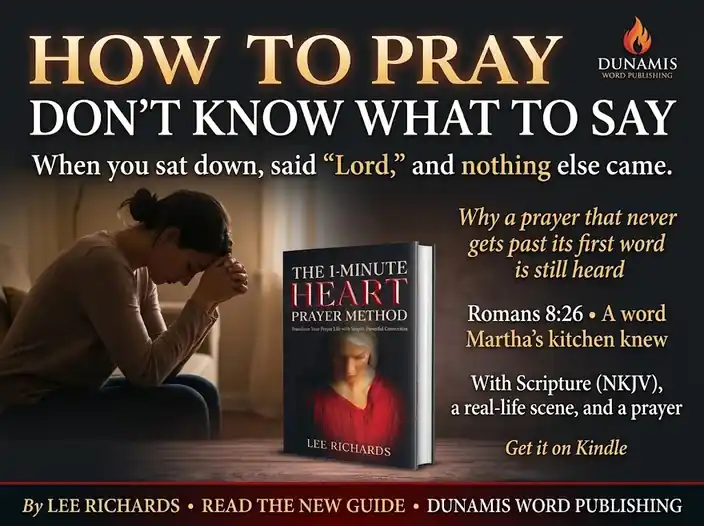
“Lord.”
That was four minutes ago, and it’s still the only word in the room.
The lamp is on. Your phone is face-down on the arm of the couch, and your hands are folded the way someone taught you when you were six. You’ve started over twice, “Father, I just…,” and both times the sentence quit in the same place, like a car that won’t turn over in January. Now you’re looking at a spot on the carpet and wondering whether a prayer that never got past its first word counts at all.
It counts. And the reason is better than anyone told you.
The short answer: When you don’t know what to say, say the little you have: a name, one plain sentence, even the word “help.” Then stop. Scripture says “the Spirit also helps in our weaknesses” at the very point where “we do not know what we should pray for as we ought” (Romans 8:26), and Jesus says “your Father knows the things you have need of before you ask Him” (Matthew 6:8). A prayer does not need finished words to be heard. It needs to be brought.
Paul Did Not Always Know What to Pray Either
Deep in Romans 8, Paul stops and says this:
“Likewise the Spirit also helps in our weaknesses. For we do not know what we should pray for as we ought, but the Spirit Himself makes intercession for us with groanings which cannot be uttered.” (Romans 8:26)
Look at the pronoun. We. Paul doesn’t put new believers in that sentence, or weak ones, or the ones who skipped church. He puts himself there. The man who wrote Romans says plainly that he does not always know what to ask for.
Now look at who does the groaning. “The Spirit Himself.” Not you. You aren’t the one who has to come up with a sound deep enough or a sentence true enough. And the next verse tells you where that wordless prayer goes: “Now He who searches the hearts knows what the mind of the Spirit is, because He makes intercession for the saints according to the will of God.” (Romans 8:27)
According to the will of God. The prayer you couldn’t word on the couch is being prayed for you, by Someone who knows exactly what to ask, in words that match what the Father wants.
The Word Martha Used
The word translated “helps” in Romans 8:26 is synantilambanomai, “to take hold together with another.” The New Testament uses it only twice.
The other time, it’s in a kitchen.
Jesus is in Martha’s house. Her sister Mary “sat at Jesus’ feet and heard His word” (Luke 10:39). Martha is on her feet, in and out of the doorway, and Luke puts it plainly: “But Martha was distracted with much serving, and she approached Him and said, ‘Lord, do You not care that my sister has left me to serve alone? Therefore tell her to help me.’” (Luke 10:40)
Help me. Take hold of this together with me. Martha wanted someone on the other end of the load.
Jesus didn’t send Mary to the kitchen. He said, “Mary has chosen that good part, which will not be taken away from her” (Luke 10:42).
Now read Romans 8:26 again. The help Martha asked for and didn’t get from her sister is the help Paul says the Spirit gives you, unasked, on the evening you don’t know what to pray. He takes hold of the other end. That leaves you free to do what Mary did: sit near Jesus with nothing finished in your hands.
So here is what you can stop doing. You can stop waiting until you have the right words before you come. You can stop rehearsing the prayer in the car so it sounds right when you finally say it. The sentence you cannot finish was never yours to carry alone.
Seven Words, Three Words
A man stands at the back of the temple, as far from the front as he can get. He “would not so much as raise his eyes to heaven” (Luke 18:13). His fist is against his chest. And this is the whole prayer: “God, be merciful to me a sinner!” (Luke 18:13)
Seven words. Jesus said that man “went down to his house justified” (Luke 18:14).
Another man is out on the water at night, and the wind is in his face. “But when he saw that the wind was boisterous, he was afraid; and beginning to sink he cried out, saying, ‘Lord, save me!’” (Matthew 14:30)
No time for a paragraph. Three words. “And immediately Jesus stretched out His hand and caught him” (Matthew 14:31).
Jesus had already told His disciples why that is enough. “And when you pray, do not use vain repetitions as the heathen do. For they think that they will be heard for their many words. Therefore do not be like them. For your Father knows the things you have need of before you ask Him.” (Matthew 6:7–8)
Then, in the next breath: “In this manner, therefore, pray” (Matthew 6:9). His knowing is not a reason to stay quiet. It is the reason you do not have to explain.
When the Words Run Out
I don’t even know what to ask for.
You’ve thought it every evening this week, standing at the kitchen sink with the water running over a pan that’s already clean. Your mother’s scans came back Thursday. The doctor said the word “options,” plural, and nobody at the table asked what they were. You’re the oldest of three, the one who makes the insurance calls. On Sunday your pastor asked how he could pray for you, and you said, “Just pray,” and walked to your car with your keys already out.
This evening you turn the water off. You keep both hands on the edge of the sink.
“Father,” you say.
The refrigerator hums. A car goes by outside.
“Mom,” you say.
That’s the whole prayer. You leave your hands where they are, you don’t add anything, and for once you don’t apologize for it.
One Honest Sentence, Then Sit
Here’s the one thing to do today. Pick one minute: the parked car, the edge of the bed, the sink. Say “Father,” and then one plain sentence about the thing in front of you, in the words you’d use with someone across your kitchen table. If all you have is a name, say the name.
Then stop talking and stay there for the rest of the minute. Don’t fill it. No second paragraph, no wrap-up, no apology for being short. You’re leaving room, the way Mary did, for the One who took hold of the other end, and for whatever He says back. If that part is new to you, here is more on how to hear God’s voice. And if you close the way you were taught, “in Jesus’ name,” that line is more than a formula; here is what it means to pray in Jesus’ name.
Scripture to Keep When the Words Won’t Come
- “Likewise the Spirit also helps in our weaknesses.” (Romans 8:26)
- “For your Father knows the things you have need of before you ask Him.” (Matthew 6:8)
- “For there is not a word on my tongue, But behold, O LORD, You know it altogether.” (Psalm 139:4)
- “Trust in Him at all times, you people; Pour out your heart before Him; God is a refuge for us.” (Psalm 62:8)
- “Let us therefore come boldly to the throne of grace, that we may obtain mercy and find grace to help in time of need.” (Hebrews 4:16)
A Prayer for When You Don’t Know What to Say
Father, I do not know what to say. You know what I need before I ask You. Here is the one thing I have: [say it plainly, or just say the name]. Holy Spirit, take hold of the rest with me, and pray what I cannot. I will sit here with You for a minute and not fill the quiet. In Jesus’ name, amen.
If short, honest prayers are the only kind you have right now, The 1-Minute Heart Prayer Method was written for you: a few true words, said to a Father who already knows, and room to hear Him answer.
I heard “Lord.” I heard it the first time, before you started over. There wasn’t a word on your tongue I didn’t already know. You don’t have to find the rest of the sentence, child. I’ve got hold of it. Sit here with Me a minute. I’m not going anywhere.
You do not have to finish the prayer to be heard. The Spirit is holding the other end.
Scripture taken from the New King James Version®. Copyright © 1982 by Thomas Nelson. Used by permission. All rights reserved.