
How to Hear God's Voice: The Shepherd Is Still Speaking
It is Sunday afternoon and the house is quiet for the first time all week.
Your Bible is open on the kitchen table. The highlighter is uncapped. You have read the chapter twice, and the words are good words, and you believe every one of them. The kettle clicks off behind you. You sit there with your hand flat on the page and wait for something more.
Someone at church said it again this morning. God told me. She said it the way you would say the weather. And you drove home wondering what she hears that you don’t, and whether the problem is you.
You have read about Him for years. But a test is not a conversation.
Here is what I want to show you. He has not been silent. You have been listening for the wrong kind of sound.
The short answer: You hear God’s voice the way sheep hear a shepherd: not by straining for a sound, but by belonging to Him and staying near. “My sheep hear My voice, and I know them, and they follow Me.” (John 10:27) He speaks through the written Word, and He speaks that Word into your moment by His Spirit, who lives in you. Learning His voice is less a skill than a familiarity, and it grows the way every familiarity grows: by time spent with Him.
Sheep Do Not Strain to Hear
Start with the promise itself: “My sheep hear My voice, and I know them, and they follow Me.” (John 10:27)
The Greek verb for “hear” is akouō. It is the ordinary word, used for hearing a knock or a crowd or a question. It is not a word for a gift some have and others lack.
And look at what He did not say. He did not say My sheep who are mature enough hear. He said My sheep. Hearing is placed on the side of belonging, not achievement. A lamb born in the fold knows the shepherd’s voice before it knows anything else. It never studied. It was simply near him, every day.
So settle this first. If you are His, you are not deaf. The ear is already there. He put it there.
Two Kinds of Word
The New Testament has two words your English Bible renders “word.” Logos is the Word as a whole: the message, the Scripture on the page, and in John’s Gospel the Son Himself: “In the beginning was the Word, and the Word was with God, and the Word was God.” (John 1:1) Rhēma is a word spoken, the thing said. Scholars will tell you, rightly, that the two overlap a great deal. But watch where rhēma turns up: “So then faith comes by hearing, and hearing by the word of God.” (Romans 10:17) “The sword of the Spirit, which is the word of God.” (Ephesians 6:17) Both are rhēma. The Word in motion, spoken into a moment.
Most of us have been handed a great deal of logos. What we have rarely been handed is rhēma: the moment a verse you have read forty times stands up off the page with your name folded into it. That is not a second Bible. It is the same Word, spoken now, by the One who wrote it. He speaks the rhēma through the logos. The page you are sitting over is not a substitute for His voice. It is where His voice most often arrives.
The One Who Speaks Lives in You
There is a reason the voice can come so near. Paul called it the mystery, the secret God kept for ages and then told: “Christ in you, the hope of glory.” (Colossians 1:27)
Not Christ above you, watching. Not Christ in a building you drive to. Christ in you. The Speaker has taken up residence in the listener. Jesus said it would be this way: “the Helper, the Holy Spirit, whom the Father will send in My name, He will teach you all things, and bring to your remembrance all things that I said to you.” (John 14:26)
So when a verse rises in you at the right moment, when a quiet knowing settles that you did not reason your way to, you are not imagining a voice from far away. You are hearing the One who is already home.
Three Doors Into This
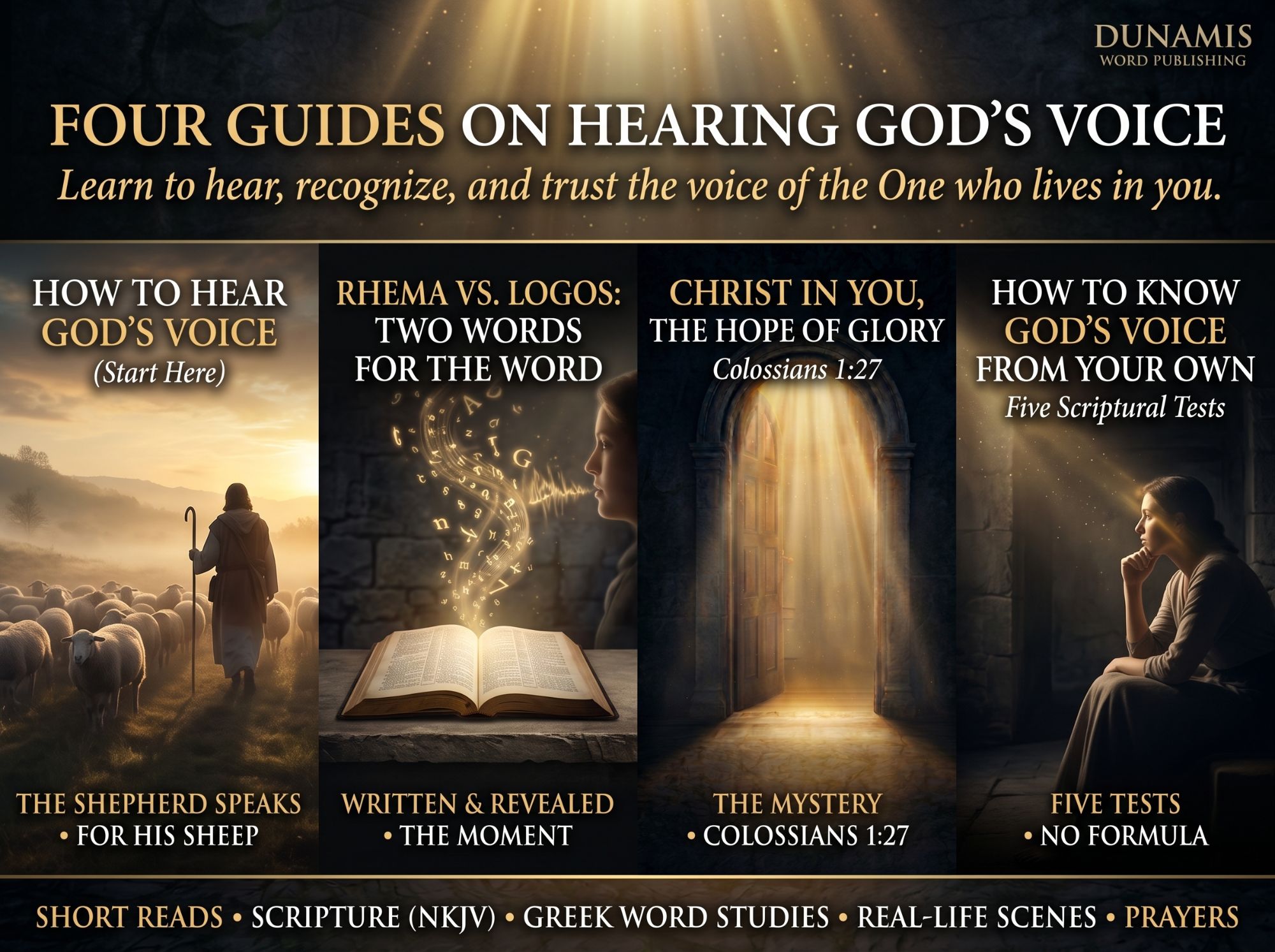
The two Greek words, and what the difference does and does not mean: rhēma and logos. The one secret Paul kept saying out loud, and the word mystērion behind it: what “Christ in you, the hope of glory” means. And the question you have carried longest, with five tests and no formula: how to know God’s voice from your own thoughts.
When You Have Never Heard Anything
Everyone else seems to have a line to Him. He is a retired machinist who has taught the fourth-grade Sunday school class for nineteen years, and every week he tells nine-year-olds that God speaks, and every week he drives home not sure He has ever spoken to him. One Tuesday he is reading Psalm 23 for the lesson, and he gets to “He leads me beside the still waters” and stops. He does not know why. He reads it again. His eyes are wet and he is a little embarrassed about it.
He sits there a long while. Then he says, to the kitchen, “All right.”
Scripture to Hear Him By
They are where the voice has been all along.
- “My sheep hear My voice, and I know them, and they follow Me.” (John 10:27)
- “So then faith comes by hearing, and hearing by the word of God.” (Romans 10:17)
- “To them God willed to make known what are the riches of the glory of this mystery among the Gentiles: which is Christ in you, the hope of glory.” (Colossians 1:27)
- “But the Helper, the Holy Spirit, whom the Father will send in My name, He will teach you all things, and bring to your remembrance all things that I said to you.” (John 14:26)
- “Your ears shall hear a word behind you, saying, ‘This is the way, walk in it,’ Whenever you turn to the right hand Or whenever you turn to the left.” (Isaiah 30:21)
A Prayer to Hear God’s Voice
You may be the one at the table with your hand on the page. Pray this once. Then open the Bible again and read slowly, not to finish, but to listen.
Lord Jesus, You said Your sheep hear Your voice. I am Yours, so I am asking You to speak, and I am asking for ears to hear it. I have read about You for years. Now I want to hear You. Take the Word I already know and speak it into this day, into this room, with my name in it. You live in me. You are not far off. Teach me the sound of You, the way a lamb learns a shepherd, by staying near. And when You speak, give me the courage to follow. In Jesus’ name, amen.
If the room stays quiet, do not decide He is silent. Come back tomorrow.
The Mystery of Christ was written for exactly this table: eighteen chapters in the voice in which He still speaks to a listening soul.
And listen for what He has been saying since you first sat down:
I have been speaking to you the whole time, child. You know My voice better than you think. Keep reading. Stay near.
You do not have to learn to hear a stranger. You have to stay near a Shepherd you already belong to.
The Mystery of Christ Guides
Each guide opens one thing about the God who still speaks, and how to hear Him. New guides are added as the series continues.
His voice: learning to hear Him
- How to Know If It Is God's Voice or Your Own Thoughts How to know if it's God's voice or my thoughts: five tests from Scripture, from agreement with the Word to the peace that makes the call. No formula.
The Word: logos and rhēma
- Rhēma vs Logos: What the Two Greek Words for Word Really Mean Rhema vs logos: what the two Greek words for word mean, where they overlap, and the difference between the Word on the page and the Word spoken to you.
Indwelling: Christ in you
- Christ in You, the Hope of Glory: What Colossians 1:27 Means What Christ in you, the hope of glory means in Colossians 1:27: the Greek word mystērion, why 'in you' may also read 'among you,' and why both are good news.
Scripture taken from the New King James Version®. Copyright © 1982 by Thomas Nelson. Used by permission. All rights reserved.