
Mary and Martha Meaning: The Good Part That Will Not Be Taken Away
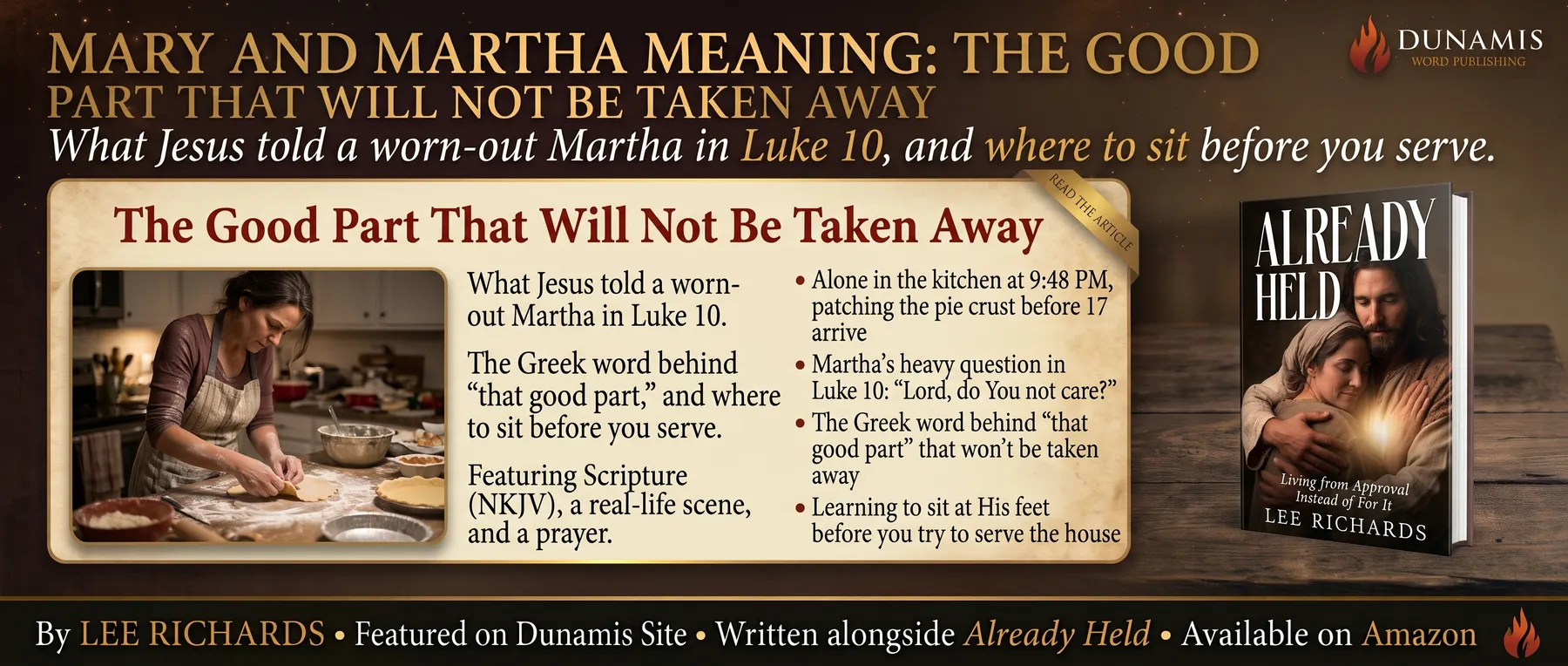
It’s 9:48 on the night before the whole family comes to your house, and there’s flour to your elbow.
The second pie crust tore when you lifted it, so you’re patching the seam with your thumb. Seventeen people tomorrow. The turkey is in a cooler of brine on the back porch. The list on the refrigerator has fourteen lines, and nine are crossed out. From the living room: the game, your brother-in-law arguing with the TV, your sister laughing at her phone. Nobody has come in to ask what they can carry.
You press the seam harder than it needs. And somewhere between the crust and the oven, the question you ask every holiday comes up again: does He even see who’s doing all of this?
The short answer: In the story of Mary and Martha (Luke 10:38-42), Jesus does not tell Martha to stop serving. He tells her what her portion is. Martha asked, “Lord, do You not care?” He answered with her name, twice, and then: “But one thing is needed, and Mary has chosen that good part, which will not be taken away from her” (Luke 10:42). “Part” is the Greek word for a portion, an assigned share, the same word the Greek Old Testament uses when the LORD tells Aaron the priest, “I am your portion.” Your place at His table is not paid for by what you carry in from the kitchen.
A Full House in Bethany
“Now it happened as they went that He entered a certain village; and a certain woman named Martha welcomed Him into her house” (Luke 10:38).
Her house. Luke says “as they went,” so He is not on the road alone. Water to draw, bread to bake, a fire to keep up, more guests than the room was built for.
“And she had a sister called Mary, who also sat at Jesus’ feet and heard His word” (Luke 10:39).
Martha passes her sister twice with her hands full. The third time, she doesn’t go to Mary. She goes to Him. “But Martha was distracted with much serving, and she approached Him and said, ‘Lord, do You not care that my sister has left me to serve alone? Therefore tell her to help me’” (Luke 10:40).
Look at the question. It is not about the bread. It is about Him. Do You not care.
You’ve asked that one. Maybe not out loud.
His Answer Starts With Her Name
“And Jesus answered and said to her, ‘Martha, Martha, you are worried and troubled about many things’” (Luke 10:41).
He says her name twice. He does not send her back to the kitchen, and He does not call the meal a mistake. He names what is pulling at her: many things. Fourteen lines on a refrigerator. (Her “help me” holds its own surprise; here is what it means for how to pray when you don’t know what to say.)
Then He gives her the one thing. “But one thing is needed, and Mary has chosen that good part, which will not be taken away from her” (Luke 10:42).
The Word for the Good Part
“Part” is meris (G3310), a portion, an assigned share. Not a role or a personality type: the share handed to you as yours.
Martha has spent the evening dishing up portions. Jesus answers her with the word for one.
The Greek Old Testament uses that same word in a place every Martha should know. When Israel’s land was promised out by tribe, the priests were left off the map. Aaron and his sons would spend their lives serving at the altar and receive no tribal land. Then God told Aaron why: “You shall have no inheritance in their land, nor shall you have any portion among them; I am your portion and your inheritance among the children of Israel” (Numbers 18:20). Both times, “portion” is meris, the share.
The man who served God for a living was not paid in land. He was given God.
David sang it: “O LORD, You are the portion of my inheritance and my cup; You maintain my lot” (Psalm 16:5). Meris again. And Paul gives thanks “to the Father who has qualified us to be partakers of the inheritance of the saints in the light” (Colossians 1:12). Where the English says “partakers of,” the Greek says “for the share,” meris, the word from Martha’s evening. The qualifying was the Father’s, and it is already done.
Now look back at Bethany. The kitchen is full of portions being made for Jesus. The good portion is not on any of the plates. It is Jesus Himself, and Mary is sitting in front of Him. Martha is cooking for the Guest who came to be her portion.
So here is what you can stop doing. You can stop trying to earn your seat at His table by what you carry in from the kitchen. The pies, the nursery Sundays, the funeral casseroles: none of it is the price of your share. The Father qualified you for it before you tied the apron, and Jesus said of that share what He said of Mary’s. It “will not be taken away.”
Martha Served Again
Look in on Bethany once more. Lazarus is alive, called out of his tomb, and there is another meal. “There they made Him a supper; and Martha served” (John 12:2).
Same Martha. Still serving. This time John records no question about whether He cares.
When Nobody Sees Who Set Up the Room
Does anybody here know who comes in at six?
You thought it at 6:20 this Sunday, on your knees behind the platform with a roll of gaffer tape, taping down the cable the drummer kicks loose every week. The sanctuary lights were still at half. Through the green-room door you could hear the worship team praying, eight voices and a guitar. You’re forty-seven, a sign installer on weekdays, and you’ve run the sound booth for eleven years.
You pressed the tape flat with your thumb. Then you sat back on your heels, which you never do before seven.
The index card your wife slipped into your Bible in October was in your shirt pocket: Luke 10:42. You read it by phone light.
“One thing is needed,” you told the empty rows.
The prayer in the green room went on without you. For once you didn’t get up to check the monitors. You stayed on the carpet with the card in your hand.
“You’re my portion. Not the board. You.”
Then the side door opened, and the first greeter came in shaking rain off an umbrella.
Sit Down Before the First Dish
Here’s the one thing to do. Before you start the next thing you serve (the holiday meal, the nursery shift, the Sunday setup), pull up a chair and sit down. Read Luke 10:41-42 out loud. Tell Him in one plain sentence what you’ve been serving to earn your place: “I’ve been cooking so You’d notice me.” Then say, “You are my portion,” and get up and start.
No promise to serve less or more. If the tiredness runs deeper than one evening, here is how to rest in God when you are tired of trying, and how to live from His approval instead of working for it.
Scripture to Keep for the Kitchen
“But one thing is needed, and Mary has chosen that good part, which will not be taken away from her.” (Luke 10:42)
“I am your portion and your inheritance among the children of Israel.” (Numbers 18:20)
“O LORD, You are the portion of my inheritance and my cup; You maintain my lot.” (Psalm 16:5)
“My flesh and my heart fail; But God is the strength of my heart and my portion forever.” (Psalm 73:26)
“giving thanks to the Father who has qualified us to be partakers of the inheritance of the saints in the light.” (Colossians 1:12)
A Prayer for When You Are Serving Alone
Father, I have been carrying the evening by myself, and I have been asking whether You care. I have been serving to earn a place at Your table, and I am putting that down. You are my portion. You qualified me for my share, and it will not be taken away. Let me sit at Your feet first, and then let me serve from there. In Jesus’ name, amen.
If you have spent years working for a place you already have, Already Held: Living from Approval Instead of For It was written for you, in the Father’s own voice.
I heard you ask if I care, child. I saw the torn crust and your thumb on the seam. I’m not asking you for another dish. I didn’t come to your house to be fed. I came to be your portion. Sit down a minute. Nobody’s taking this from you.
You were cooking for the Guest who came to be your portion.
Keep Reading
Scripture taken from the New King James Version®. Copyright © 1982 by Thomas Nelson. Used by permission. All rights reserved.